Dentist Can Sağlat · Bitez, Bodrum
Orthodontics
Orthodontics deals with correcting the position of crowded, gapped or misaligned teeth. The aim is not only appearance; it is also to make the teeth easier to clean, to balance the bite and to make chewing more comfortable. On this page we explain when orthodontic treatment is considered and the methods used at our practice in Bitez, Bodrum.
When is it considered?
- If the teeth are crowded or overlapping.
- If there are noticeable gaps between the teeth.
- If the upper and lower teeth do not meet correctly (at the front, at the side or with a deep bite).
- If crowding makes the teeth hard to clean.
- If the position of the teeth needs correcting before treatment such as an implant or a crown.
At what age?
In children it is important to monitor the development of the teeth and jaws early; some problems can be guided more easily during growth. However, teeth can be moved at any age. Orthodontic treatment can also be carried out in adults whose jaw development is complete, as long as the gums and bone are healthy.
Methods
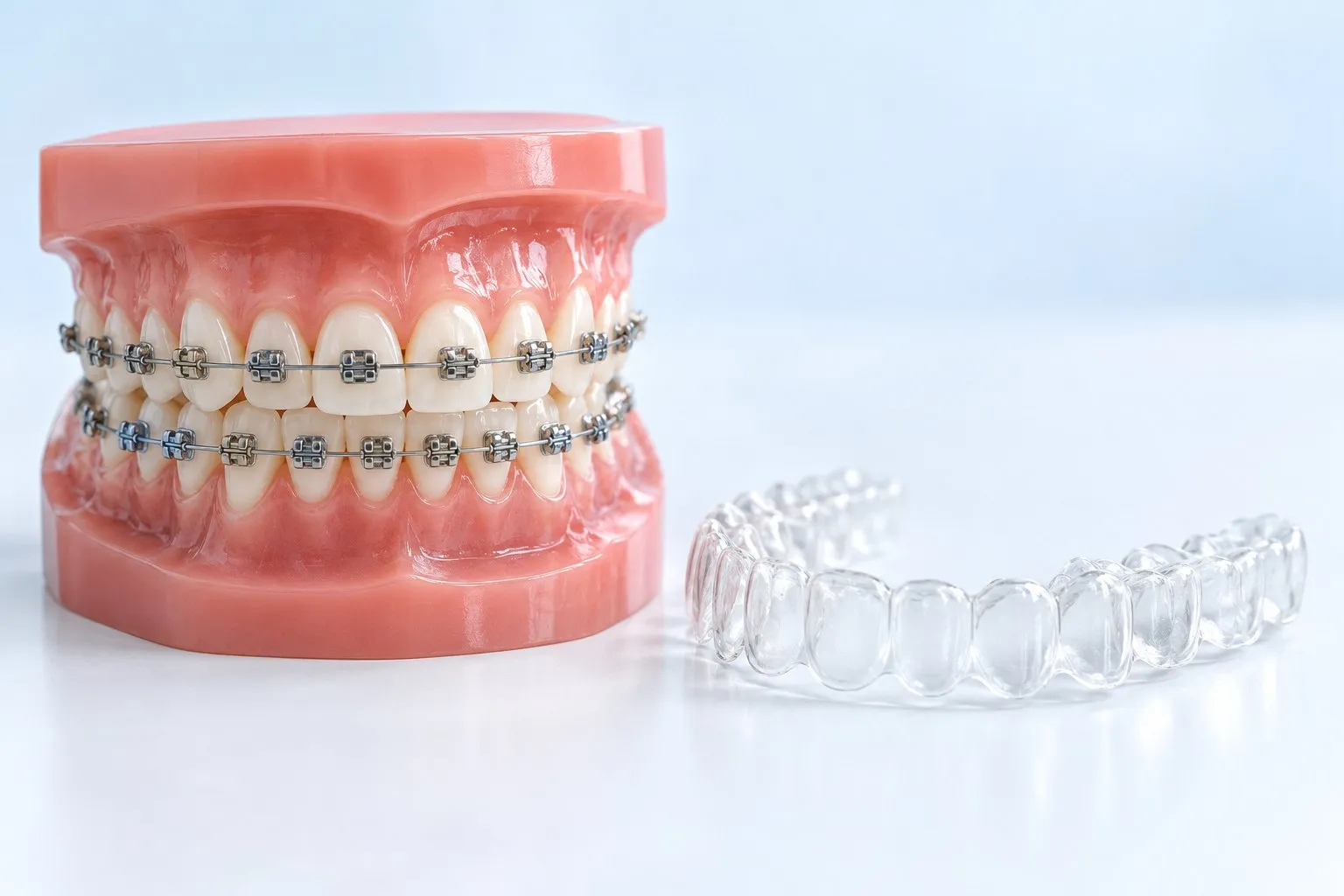
Fixed braces
Small brackets bonded to the teeth and the wires that connect them move the teeth in a controlled way. Check-ups and wire adjustments are carried out at regular intervals throughout treatment. Because braces are fixed, they do not depend on the patient remembering to wear them; on the other hand, keeping them clean needs more care.
Clear aligners
A series of clear, removable aligners, planned from a digital scan of the teeth, is worn in turn. Each aligner moves the teeth a small amount. The aligners can be taken out for eating and brushing; however, to be effective they need to be worn for most of the day, usually 20–22 hours.
Clear aligners are often used for mild and moderate crowding. On their own they may not be enough for complex skeletal bite problems.
We decide together which method suits you, based on the condition of your teeth, your bite, your expectations and whether you will be able to wear aligners consistently. With either method, orthodontic treatment is carried out at our practice, from planning to retention.
How does the process work?
- Examination and records: an examination of the mouth, X-rays, photographs and a digital impression with an intraoral scanner.
- Planning and explanation: we explain the treatment options, the estimated duration, how often check-ups are needed and the possible risks.
- Starting treatment: the brackets are bonded or the first aligners are handed over.
- Check-ups: progress is checked at regular intervals.
- Retention: after treatment, a retainer (a fixed wire or a night-time retainer) is used so that the teeth do not move back to their old position.
Risks and things to be aware of
During treatment the teeth may feel temporarily sensitive and under pressure. If cleaning is not thorough enough, decay, white spots and gum inflammation can develop around the brackets. In some cases root shortening or gum recession may occur. If a retainer is not used after treatment, the teeth may move back towards their original position.
Frequently asked questions
Can braces be used at any age?
Teeth can be moved at any age. In adults, what matters is that the gums and bone are healthy. We assess this before treatment begins.
Are clear aligners as effective as braces?
Clear aligners can be effective for mild and moderate crowding. For complex bite problems, fixed braces may be more suitable. We discuss which suits you at the examination.
How long does treatment take?
The time depends on how much the teeth need to move and the method used; it usually takes months and in some cases more than a year. We explain the estimated time for you at the planning stage.
Will my teeth move back after treatment?
Teeth tend to move back towards their old position. That is why it is important to wear the retainer after treatment as your dentist recommends.