Dentist Can Sağlat · Bitez, Bodrum
Crowns and Bridges
A crown is a cap that fits exactly over a tooth and covers it from the outside. A bridge consists of crowns joined together that fill the gap left by a missing tooth, supported by the teeth on either side. On this page we explain when crowns and bridges are considered and how they are made at our practice in Bitez, Bodrum.
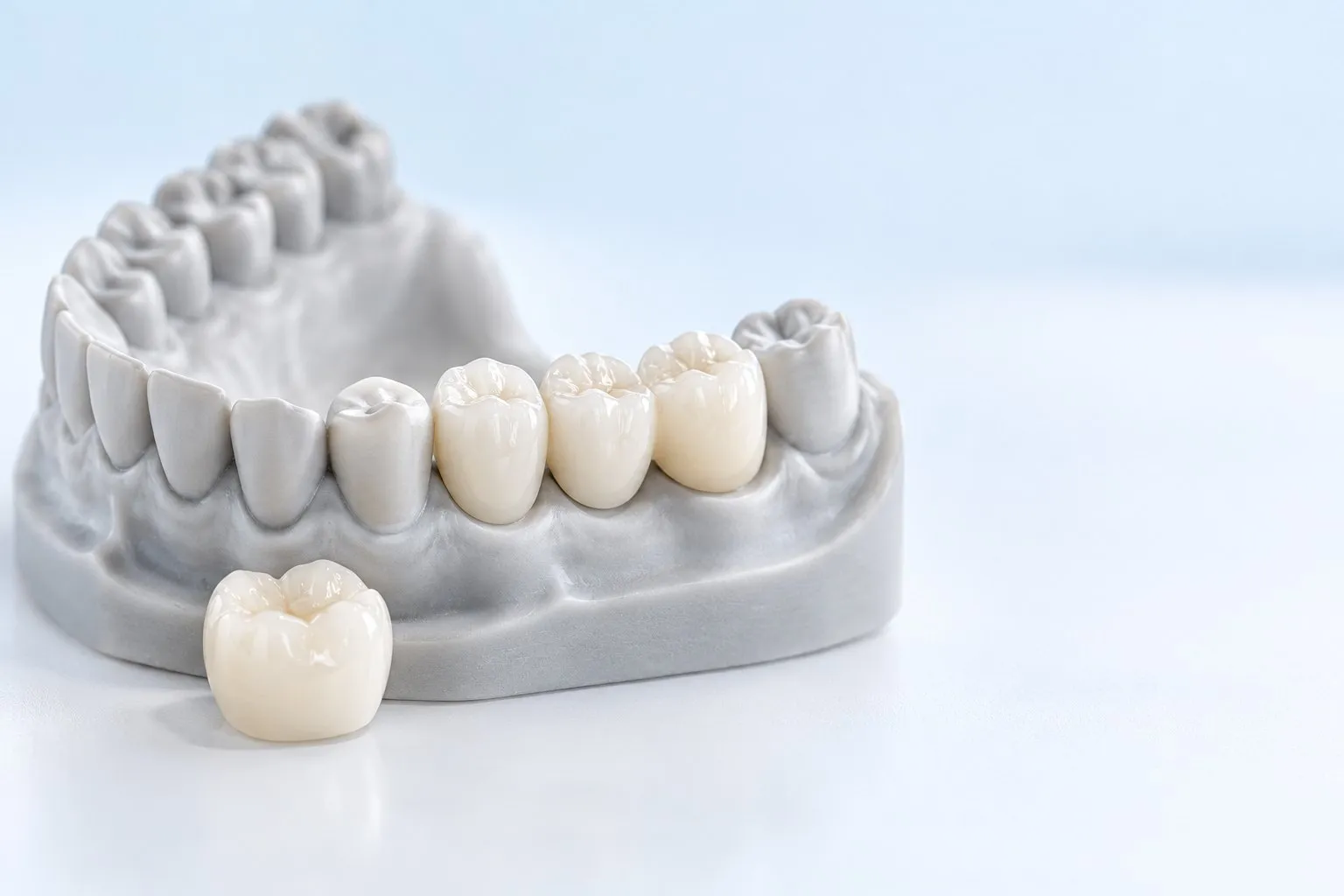
When is a crown needed?
- Badly broken-down teeth: to protect teeth that have lost too much structure to be repaired with a filling.
- Teeth that have had root canal treatment: especially back teeth, to reduce the risk of fracture.
- Cracked or broken teeth: to hold the tooth together.
- Worn teeth: to restore function where clenching or grinding has caused advanced wear.
- On an implant: as the restoration on an implant that has fused with the bone.
When is a bridge considered?
If one or more teeth are missing and the teeth on either side of the gap are able to carry a bridge, a bridge is an option. A bridge requires the supporting teeth to be reduced. That is why we explain the bridge together with the other options, such as an implant or a removable denture, with their pros and cons.
Choice of material
Crowns and bridges can be made from different materials, such as all-ceramic, zirconia or porcelain fused to metal. In some cases, permanent crowns in ceramic-reinforced resin can also be made on the 3D printer at the practice. Which material is suitable depends on the position of the tooth, the chewing forces, the opposing teeth, any clenching habit and your expectations for appearance. We do not recommend one material for everyone; we assess the options together at the examination, based on your situation.
How does the process work?
- Examination and X-rays: the condition of the tooth and its root is assessed, with a panoramic or periapical X-ray if needed. If necessary, root canal or gum treatment is carried out first.
- Planning and explanation: we explain the options, stages and possible risks, and make the decision together.
- Preparing the tooth: under local anaesthetic, the tooth is reduced just enough for the crown to fit. We wait for the anaesthetic to take full effect.
- Digital impression: the impression is taken digitally with an intraoral scanner. As no impression material is used, it can be more comfortable for patients who feel like gagging with conventional impressions.
- Temporary crown: a temporary cap is made to protect the tooth until the permanent crown is ready.
- Try-in and adjustment: the permanent crown is tried in the mouth; the bite, colour and fit with the gum are checked. Adjustments are made if needed.
- Fitting and check-up: once the fit is confirmed, the crown is cemented and a check-up appointment is planned.
Risks and things to be aware of
Reducing a tooth cannot be undone. After reduction there may be sensitivity to hot and cold for a while; some teeth may need root canal treatment later. If the edge of the crown is not cleaned well, decay and gum inflammation can develop there. In people who clench their teeth, the risk of the ceramic chipping can be higher; in that case we may recommend a night guard.
Care
Crowns and bridges do not decay, but the teeth underneath and beside them can. Brushing twice a day, cleaning under the bridge and between the teeth with interdental brushes or bridge floss, and regular check-ups are needed.
Frequently asked questions
Does the nerve have to be removed when a crown is made?
Not always. A crown can be made on a healthy, living tooth without touching its nerve. If the tooth has deep decay, inflammation or pain, root canal treatment may be needed first. We assess this with X-rays and an examination.
How long does it take to complete a crown?
It usually takes a few appointments: preparation and impression, try-in and fitting. The time varies depending on whether preliminary treatment is needed; we make the plan together after the examination.
How long does a crown last?
That depends on oral care, any clenching habit, the material used and regular check-ups. We do not promise a particular length of time; the aim, with care and check-ups, is for it to last a long time.
A bridge or an implant?
Each has its own advantages and limits. A bridge requires the neighbouring teeth to be reduced; an implant is a surgical procedure and needs enough bone. We discuss which suits you after the examination and imaging.