Dentist Can Sağlat · Bitez, Bodrum
Dental Implants
A dental implant replaces a missing tooth: it is a small component placed in the jawbone that takes over the role of the tooth’s root. A single tooth (crown), a bridge or a denture can be fixed on top of it. On this page we explain what an implant is, who it may suit and the stages treatment goes through at our practice in Bitez, Bodrum.
What is a dental implant?
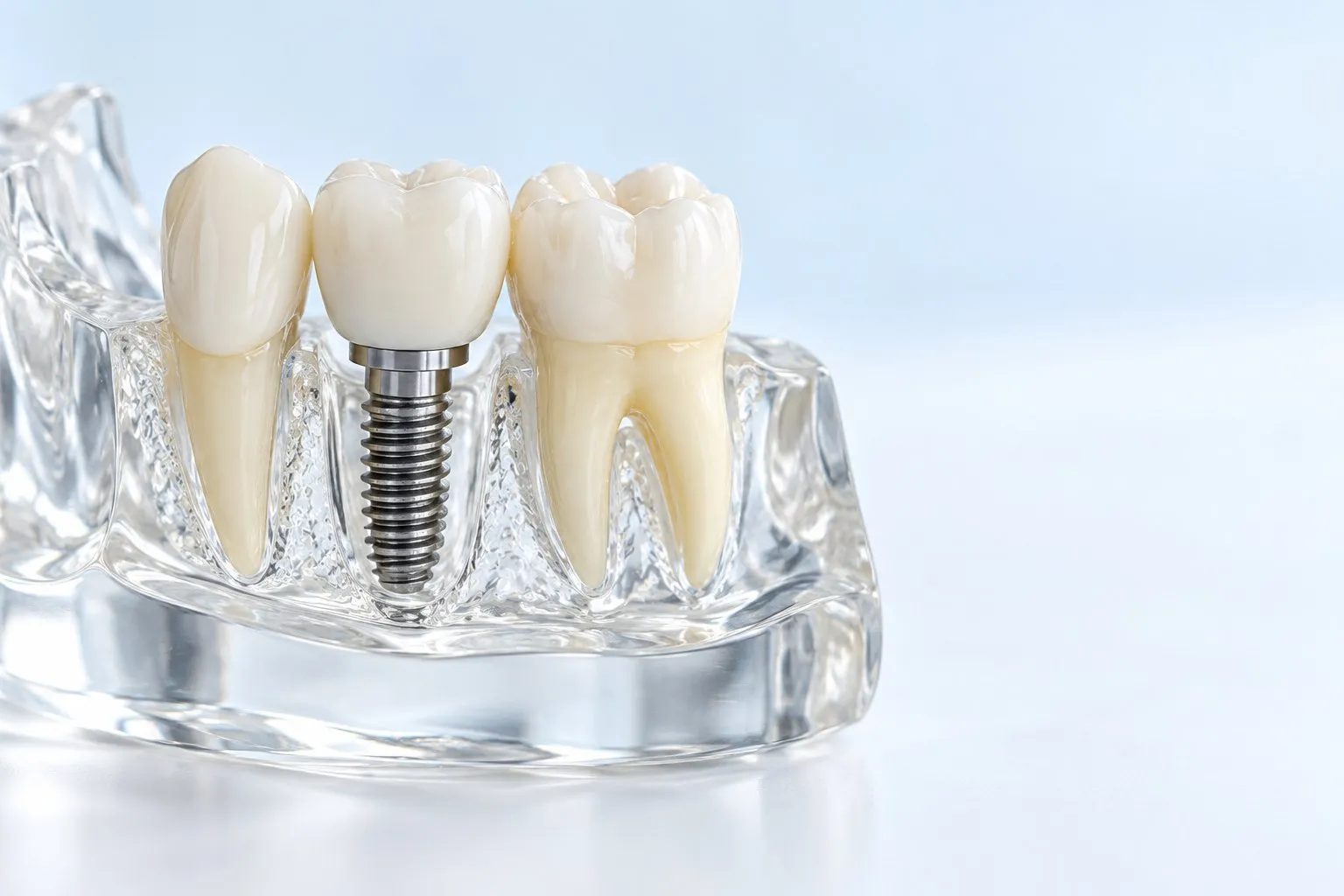
An implant is an artificial root in the shape of a screw, usually made of titanium. Once placed in the jawbone, it fuses with the bone over a few months. When this fusion is complete, a restoration that matches the other teeth (a crown, bridge or denture) is made on top of it.
An implant is not a “tooth” in itself; it replaces the root of the tooth. The visible part is the restoration made on top.
When is it considered?
- If a single tooth is missing: to fill the gap without touching the neighbouring teeth.
- If several teeth are missing: a bridge can be made on a few implants.
- If no teeth are left: to help a removable denture stay in place or to carry a fixed denture.
When nothing replaces a missing tooth, the neighbouring teeth can tilt into the gap over time, the opposing tooth can over-erupt and the bone in that area can thin. An implant is only one of these options; a bridge and a removable denture are also considered together at the examination.
What do we assess at the examination?
An implant may not be suitable for every missing tooth. At the examination we look at:
- Bone volume and quality: the height and width of the bone and the position of the nearby nerve and sinus are assessed with three-dimensional imaging (a CT scan). If there is not enough bone, additional procedures to support it may be needed first.
- Gum and oral health: if there is gum disease, it is treated first.
- General health: conditions such as uncontrolled diabetes, certain bone medications or radiotherapy to the head and neck can affect the plan. We discuss your medicines and medical history at the examination.
- Smoking: smoking can have a negative effect on healing and on the implant fusing with the bone.
- Age: in young people whose jaw development is not complete, implants are usually postponed.
How does treatment proceed?
- Examination and X-rays: we examine your mouth and make an initial assessment with the panoramic and periapical X-rays at the practice.
- Three-dimensional imaging (CT scan): we do not place an implant without planning it on a CT scan. As there is no CT scanner at our practice, we refer you to an imaging centre; if you wish, we accompany you.
- Planning and explanation: we plan the position of the implant in three dimensions on the CT images and explain the options, stages, timing and possible risks. The decision is made together, once your questions have been answered.
- Preliminary procedures if needed: if a tooth needs to be extracted, there is not enough bone or the upper jaw is close to the sinus, additional procedures such as bone support or a sinus lift may be planned.
- Placing the implant: the procedure is carried out under local anaesthetic. We wait for the anaesthetic to take full effect and check with you before we begin.
- Healing period: we wait for the implant to fuse with the bone. During this time, especially at the front of the mouth, a temporary solution may be planned.
- Impression and restoration: once fusion is complete, a digital impression is taken with an intraoral scanner and the crown, bridge or denture on the implant is prepared.
- Check-ups: after the restoration is fitted, regular check-ups are planned.
Each stage is carried out in its own time, in line with the five standards of slow dentistry.
How long does it take?
The time depends on the amount of bone, whether preliminary procedures are needed and how healing goes. From placing the implant to fitting the restoration usually takes a few months. We discuss the exact timing, with a plan tailored to you, after the examination and imaging.
If you are coming from outside Bodrum, keep in mind that treatment needs more than one visit and that there is healing time between stages. We plan your visits together accordingly.
Risks and things to be aware of
An implant is a surgical procedure and, like any surgery, carries some risks. For a few days afterwards there may be swelling, bruising and tenderness. Less often, infection, the implant not fusing with the bone, or problems related to the nerve in the lower jaw or the sinus in the upper jaw may occur. In the long term, inflammation of the gum and bone can develop around implants that are not cared for properly.
We explain these risks, and any that are specific to your situation, in detail before treatment begins.
Caring for your implant
An implant does not decay, but the gum and bone around it need the same care as natural teeth. Brushing twice a day, using interdental brushes or floss between the teeth and regular check-ups help the implant stay healthy for a long time.
Related treatments
Frequently asked questions
How long does implant treatment take?
It depends on the amount of bone, whether preliminary procedures are needed and how healing goes; it usually takes a few months. We plan the timing for you together after the examination and imaging.
Will I feel pain during the procedure?
The implant is placed under local anaesthetic. We wait for the anaesthetic to take full effect and check with you before we begin. For a few days afterwards there may be tenderness and swelling; we explain separately what to do during this time.
Can I have an implant if I do not have enough bone?
Not having enough bone does not always rule out an implant. Depending on your situation, additional procedures to support the bone may be planned, or another treatment option may be more suitable. We assess this together on the CT images.
Why is a CT scan needed?
A panoramic X-ray shows the jaw in two dimensions. A CT scan shows the width and height of the bone and the position of the nearby nerve and sinus in three dimensions. As we plan the position of the implant with this information, we do not place implants without a CT scan. As there is no CT scanner at our practice, we refer you to an imaging centre; if you wish, we accompany you.
Does an implant last a lifetime?
How long an implant lasts depends on your general health, oral care, smoking and regular check-ups. That is why we do not promise a particular length of time; the aim, with care and check-ups, is for it to last a long time.
What happens if I do not replace a missing tooth?
The neighbouring teeth can tilt into the gap over time, the opposing tooth can over-erupt and the bone in that area can thin. We discuss which option suits you at the examination.