Dentist Can Sağlat · Bitez, Bodrum
Veneers
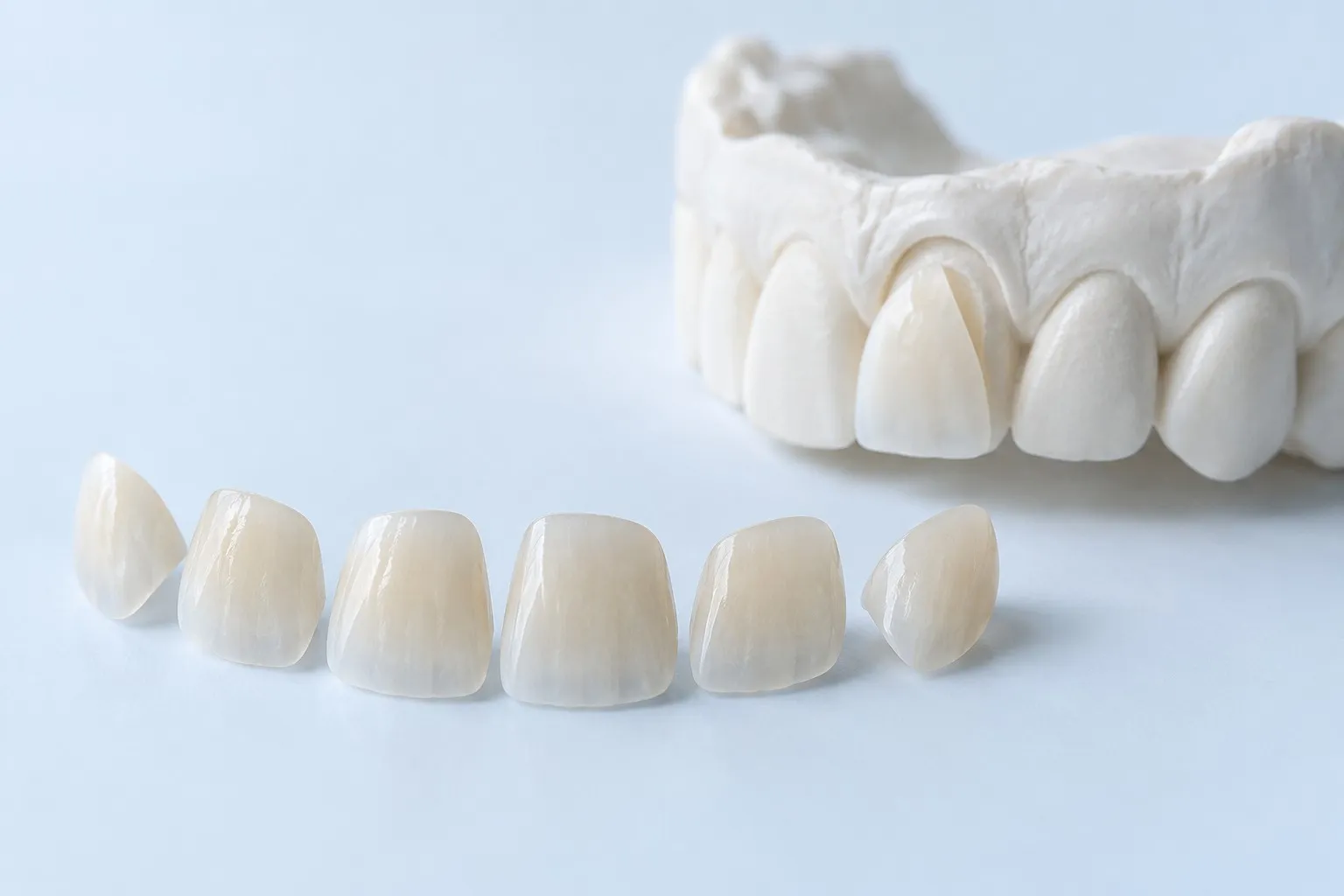
A veneer is a thin covering that covers only the front surface of a front tooth. It is used to change the colour, shape or length of a tooth. At our practice we make ceramic (porcelain) and composite veneers. On this page we explain who veneers are suitable for, who they are not suitable for, and how they are made at our practice in Bitez, Bodrum.
When are veneers considered?
- Discolouration that does not respond to whitening: for example, darkening caused by certain medicines or by tooth development.
- Differences in shape and length: teeth that are small, short or shaped differently from the others.
- Small gaps: closing small gaps between the front teeth.
- Chipped or worn edges: where the loss is small and the rest of the tooth is sound.
If the only concern is colour, we first discuss whitening; it often gives a satisfactory result without touching the tooth at all.
Who do we not recommend them for?
- People with gum disease: the gums are treated first; a veneer does not stay well adapted on gums that are not healthy.
- People who clench or grind their teeth: the forces on the veneer increase the risk of it breaking or coming off.
- Teeth with extensive decay: the decay is treated first. If a tooth has lost a lot of structure, a crown may be more suitable.
Ceramic and composite veneers
- Ceramic (porcelain) veneers: made in the laboratory from a digital impression and bonded to the tooth. They keep their colour for a long time and are completed in three appointments.
- Composite veneers: made from a tooth-coloured filling material that bonds to the tooth; in some cases they are built up layer by layer directly on the tooth in the mouth. They are usually completed on the same day and can be repaired if needed; over time they may change colour and need polishing.
Which type is suitable depends on the condition of your teeth, your bite and your expectations; we discuss the options together at the examination.
Does the tooth need to be reduced?
Where the case allows, we make veneers with no reduction or with very minimal reduction (prepless). With veneers placed without reduction, the teeth become slightly thicker, so they are not suitable for every tooth or every bite. If reduction is needed, usually only a thin layer of enamel is removed. Reduction cannot be reversed; we explain how much reduction is needed before we begin.
How does the process work?
Ceramic veneers are completed in three appointments:
- Examination, X-rays and digital impression: the condition of the teeth and gums is assessed. The impression is taken digitally with an intraoral scanner, and we talk about your expectations.
- Trial in the mouth (mock-up) and preparation: the planned shape is applied temporarily over your teeth. You see the result in your own mouth, in the mirror, and assess it; if needed, we change the shape and length together. Once you approve, the teeth are prepared if needed and the final impression is taken.
- Try-in and bonding: the veneers are tried in the mouth; once the colour, fit and bite have been checked, they are bonded. A follow-up appointment is then planned.
Composite veneers are usually completed on the same day, in a single session.
Risks and things to be aware of
A veneer can break or come off; biting hard objects (such as pens, fingernails or nutshells) increases this risk. Teeth that have been reduced may be sensitive to hot and cold for a while. If the edge of a veneer is not cleaned well, decay and gum inflammation can develop there. The colour of a veneer does not change with whitening; if you are thinking of whitening the neighbouring teeth, this needs to be done before the veneers.
Care
Brushing twice a day, cleaning between the teeth with floss or interdental brushes, and regular check-ups are needed. With composite veneers, the surface polish can be renewed at check-ups.
Frequently asked questions
Do veneers damage the teeth?
With veneers placed without reduction or with very minimal reduction, the tooth itself is largely preserved. If reduction is needed, it cannot be reversed; so we explain how much reduction is needed before we begin, and we make the decision together.
Veneer or crown?
A veneer covers only the front surface of the tooth and requires less tooth structure to be removed. A crown covers the whole tooth; it may be more suitable for teeth that are badly broken down or have had root canal treatment. We assess which is suitable together after the examination.
Can I see the result beforehand?
Yes. You see the planned shape on your own teeth with a trial in the mouth (mock-up). We move on to the permanent veneers only after you have seen and approved the result.
How long do veneers last?
This depends on oral hygiene, any clenching habit, the material used and regular check-ups. We do not promise a particular length of time; with care and check-ups, the aim is long-term use.